970,000+
Synchronised LED Neurons

A volumetric organism of light, water and intelligence. It senses the crowd, it dreams in mathematics, and it renders the space between bodies in real time.
Yours matters. The more people gather and move together, the more radically the temple transforms.
Nearly one million points of light hang above and around you. The structure breathes. It shifts. It perceives — not as a mirror, but as a mind.
This is not an installation you watch from a safe distance. You are part of it from the moment you cross the threshold. The system is always reading — who is here, how they move, what the group is becoming.
At the centre, a column of light descends into a black pool of water. Tungsten weights graze the surface; a motorised core sends micro-vibrations rippling outward. When the crowd truly aligns — moving together, attending together — the whole space enters a different state. It is difficult to describe. You feel it.
Organysmo is the embodied ritual where the universe — and your reflection within it — is finally rendered complete.
The Nártex is a threshold between two worlds. On one side, Sónar's exterior realm of rhythm and collective intensity; on the other, a parallel inner dimension where perception shifts and familiar rules dissolve.
Crossing it is not merely spatial movement but a change of state — sound, light and scale recalibrate the senses and prepare the body to enter an architecture that belongs to another universe.

We abandoned conventional linear numbering — the field is not counted 1 through 121. Instead the body is mapped outward from a single point in both directions: 1 · 2 · 3 · 4 · 5 · 6 · 5 · 4 · 3 · 2 · 1, where the count rises to the edge and falls back toward the source. The Axis Mundi sits at the heart of it, and 6 is the only value that repeats — at the dead centre, and again at every corner.
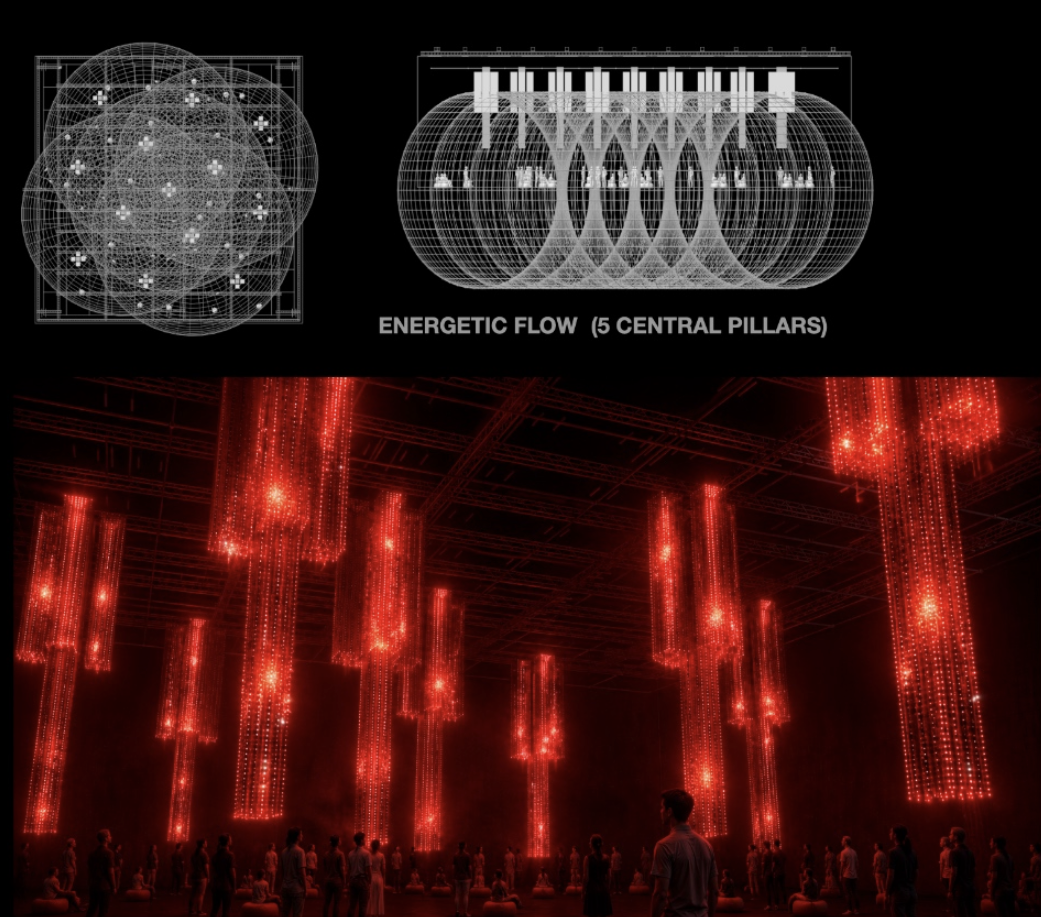
Ancient Sanskrit had no negative numbers. In their place stood a different idea: balance — not excess, not depth, but equilibrium. That is the principle the geometry encodes. The shape this energy describes is a toroid: an expansion from the centre — the elemental symbol of the structure, turning a rigid grid into a living, organic system.
The DragonO volumetric display is a three-dimensional matrix of hundreds of thousands of LED Neurons that coexist within our own dimension. Its density and precision materialise three-dimensional images in mid-air — light that occupies space without fully submitting to its rules.
THE AXIS MUNDI IS THE VERTICAL THRESHOLD CONNECTING THE TERRESTRIAL AND THE CELESTIAL — THE POINT WHERE TWO REALITIES MEET. IN THIS INSTALLATION, THAT ANCIENT SYMBOL IS REBUILT AS A LIVING SYSTEM, WHERE WATER CLOSES THE CIRCUIT BETWEEN THE CROWD AND THE LUMINOUS ORGANISM ABOVE.
THE DRAGON DESCENDS FROM ABOVE. BENEATH IT, A FIELD OF STILL WATER. A MIRROR THAT HOLDS ITS PERFECT INVERSE. YOU STAND INSIDE THE AXIS ITSELF. WHAT HAPPENS NEXT DEPENDS ON THE STATE OF THE FIELD.
Brunelleschi INVENTED THE VANISHING POINT — THE FIXED EYE FROM WHICH ALL LINES CONVERGE TOWARD A HORIZON THAT NEVER MOVES. FIVE CENTURIES OF ARCHITECTURE AND DESIGN WERE BUILT ON THAT ASSUMPTION: THAT SPACE EXISTS INDEPENDENTLY OF YOU.
AT SÓNAR, THAT ASSUMPTION ENDS. 88 PERCEPTION NODES READ THE CROWD. 140 MOTORS DEFORM THE SPATIAL GRID.
THE VANISHING POINT IS NO LONGER DRAWN IN ADVANCE — IT EMERGES FROM WHERE COLLECTIVE ATTENTION CONVERGES.
Each of the twelve columns carries an independent motor at its core, with a vertical movement range of up to three metres — the tallest reaching nine metres from the rigging. The system operates far beyond overt motion, generating shifts almost imperceptible to the eye.
Although the columns read as solid, fixed, immovable, their subtle motion quietly disrupts that assumption. The result is a profound subconscious effect: the very definition of what is solid begins to dissolve, and the space appears to undulate and reconfigure itself from within.
The resting grid — ordered, predictable, the Matrix as the expression of structure.
The grid bends in mirrored harmony — order bent without breaking.
Displacement without pattern — the living, breathing surface of the body.
The grid turns against itself — gravity rendered an illusion.
A Linux-based perception core pairs a custom top-down vision model with a language model that performs rational analysis of the crowd — not parametric tracking, but genuine reading.
How are people feeling? Are they interacting? Is the collective energy rising or falling? The system answers, remembers, and compares against what came before.
101 active cells, each a light source and a sound source. Content is not designed frame by frame — it is generated through sequences born of golden sections, phyllotaxis, harmonic series and binary growth.
The instrument is played with intent, not software. You express a wish; the temple translates it into harmony.
A 16-channel spatial audio system distributes sound volumetrically — moving vertically and horizontally in dialogue with the kinetic grid above, with millimetric precision the industry calls exotic.
Low tones create physical resonance, mid-range shapes proximity, highs define direction. I hear the colours. I see the sounds.
The machine does not dream in the abstract. It dreams from the point of contact.
Every dream begins at an Origin Cell — set by the Perception System the instant a frequency holder, the person with the highest coefficient of attention, enters or activates a zone. From that cell, a mathematical law decides which cell fires next, and in what order. The same logic drives both light and sound: the origin cell is always the root note, and every other cell is assigned a pitch by its distance and angle from the source. Every sequence stays harmonically coherent from any starting point.
When a frequency holder enters or activates a zone, that cell becomes the starting point. The machine does not dream in the abstract — it dreams from the point of contact.
The rule that determines which cell fires next, and in what order. Some expand like ripples, some follow prime intervals, some trace the rings. The rule is what gives each dream its identity.
Three phases — a fast fade-in as the cell wakes, a hold while it is fully alive, a slow fade-out as it dissolves. The ratio is a parameter: tightened for urgency, stretched for contemplation.
Each cell is a sound source. Pitches are assigned dynamically relative to the origin — whichever cell receives the trigger becomes the root note. The origin always plays the tonic.
Beneath the dreaming, the body keeps its own autonomic rhythms.
Where the sequences are the conscious imagination of the machine, the behaviours are its involuntary life — overlaid renders that run continuously underneath, the way breath and pulse run beneath thought. Layered together, they give the organism the texture of something alive rather than something played.
A slow expansion and contraction across the whole body — the grid drawing in and releasing as one continuous surface. An overlayed render that never resolves into a beat, only a tide.
A pulse propagating outward from the core — brightness rising and falling on a frequency the body can feel before it can see. The closer the crowd aligns, the more the pulse synchronises.
The two rhythms layered into one field — the slow tide of breath carrying the faster pulse of the heart. This is the organism at rest: not performing, simply alive.
Organysmo is not only an experience. It is a research project in progress.
Every deployment teaches us something. Sónar — our most ambitious chapter — sharpens these questions rather than answering them.
Perception reads the room. Cognition builds a model of what the group is becoming. The system remembers not through storage, but through learning. At what point does a responsive system stop being a machine and start being something else?
Where a crowd focuses is where perspective converges. The vanishing point is not drawn — it emerges. Organysmo makes it fluid, collective and alive. What happens to a space when the observer is no longer singular, but collective?
The Dragon does not log events. It remembers through inertia — patterns that recur are reinforced, sudden changes absorbed, continuity preserved across the noise of a crowd. Something closer to the way a body learns a habit.
Temples were never only places of religion — they were devices of transformation, designed to shift consciousness through light, proportion and collective presence. Organysmo inherits that purpose, and tries to produce it behaviourally.

Sónar is one of the world's defining gatherings at the intersection of music, creativity and technology — a place where artists, technologists and thinkers converge to ask what comes next.
For this chapter, Organysmo arrives not as a demonstration of what technology can do, but as a living question about what it feels like when technology and human presence become one system — a post-modern temple that fuses sound and light into a single immersive field, echoing Barcelona's bold spirit.

We design volumetric systems that sense, think, and transform environments into collective experiences. Every organism we build is powered by our patented neuronal LED architecture, developed over a decade of research and live deployments worldwide.
DragonO is an exclusive experience. Its hardware, software and content-management tools have been created entirely by LedPulse technologies — from Coachella and Art Basel to the World of Volvo, Mercer Labs and Milano Design Week.
Explore LedPulse →Yours matters. The more people gather and move together, the more radically the temple transforms.